
WDFW Study Shows Juvenile Chinook Salmon Face Cocktail Of Chemicals In Urban Waters, Dozens Of Contaminants Found In Fish

Above photo: Crowds gather on a bridge at the Issaquah Salmon hatchery to watch as salmon return to spawn.

A new study led by the Washington Department of Fish and Wildlife’s Toxics Biological Observation System unit explores an unseen threat to the Pacific Northwest’s Chinook salmon — chemical contamination.

Among the findings of this research — published online earlier this summer and in the October issue of the journal Environmental Pollution — is the discovery that a half-dozen “contaminants of emerging concern” are found in juvenile Chinook salmon throughout Puget Sound, indicating sound-wide exposure to these contaminants. In the Duwamish, the most developed watershed included in the study, 11 contaminants also exceeded thresholds indicating the potential to affect fish physiology, behavior, and fitness.

Chinook salmon are vulnerable to contaminants in part because of the time they spend in nearshore marine habitats and estuaries, areas that can be subject to high pollutant runoff. As these fish transition from freshwater to saltwater on their way to the open ocean, they undergo a stressful physiological change called smoltification, which heightens their susceptibility to other stressors.

Ultimately, WDFW researchers, in partnership with researcher James Meador of the University of Washington, found a cocktail of contaminants of emerging concern (CECs) in the sampled salmon. The CECs tested for include a mix of chemicals found in everyday products, stormwater, and wastewater, such as pharmaceuticals, personal care products, PFAS (‘forever chemicals’), and pesticides currently in use.

“The results of this study suggest that juvenile salmon are exposed to a variety of emerging contaminants as they migrate through urbanized river systems within Puget Sound,” said Molly Shuman-Goodier, WDFW research scientist and lead author on the study. “Many of these CECs have little to no previous data to describe their potential impacts on salmon or other marine life.”

The study detected dozens of these chemicals, including:

• Pharmaceuticals: Antibiotics like oxytetracycline and other substances like ibuprofen and caffeine.

• Personal Care Products: The insect repellent DEET and compounds found in soaps and cleaners.

• PFAS: So-called “forever chemicals” — used to waterproof clothing and as coating for non-stick cookware — that do not break down in the environment.

The study analyzed Chinook salmon from five Puget Sound watersheds — the Skagit, Snohomish, Green/Duwamish, Puyallup/White, and Nisqually. The data included samples collected over the course of a decade (2013–2023) representing Chinook less than a year old. WDFW tested these fish for up to 219 contaminants of emerging concern, including pharmaceuticals and personal care products, PFAS, pesticides currently in use today, and alkylphenols, which are found in everyday products like detergents and other household cleaners.

In all, six chemicals were observed to be ubiquitous in juvenile Chinook salmon collected across all five watersheds, including the alkylphenols 4-NP and NP2EO, X-ray contrast agent iopamidol, PFOS, oxolinic acid, and DEET.

In the region’s most urbanized watershed, the Green/Duwamish, 11 contaminants also exceeded biological effects thresholds, including the antibiotics oxytetracycline, tetracycline, and erythromycin-H20, the insect repellent DEET, and the pharmaceuticals metformin, ibuprofen, valsartan, norfluoxetine, citalopram, caffeine, and hydrocortisone.

Testing, monitoring, and regulation for most CECs in surface water is not required, making it difficult to assess their full impact on the ecosystem. However, by comparing the detected concentrations to existing data and models, researchers could infer some of the potential biological effects. Several of the detected chemicals, particularly pharmaceuticals, were at levels that could negatively impact the salmon’s physiology, behavior, or survival. For example, the study found antidepressants like citalopram and norfluoxetine, as well as caffeine, at levels that could alter fish behavior.

While the study revealed general regions where PFAS may be entering the studied waterways, identifying where these pharmaceuticals and personal care products are entering the watersheds proved much more difficult, suggesting they may be largely entering the water through multiple generalized inputs, like stormwater runoff or wastewater.

To protect threatened salmon species and promote population recovery efforts, the study authors recommend continuing efforts to identify the sources of these varied contaminants, alongside strategies to remove or reduce CECs in stormwater and wastewater. WDFW is among the organizations working to better understand the varied ways contaminants enter and concentrate in the waters of Puget Sound, as well as identifying methods to address contamination.

“There’s a large gap in understanding how and where these contaminants are entering our waterways, which makes the problem difficult to address,” said Shuman-Goodier. “By identifying which contaminants are present and at potentially concerning levels, we can help prioritize where to focus future research and management actions.”

Additionally, the 11 CECs identified as a potential concern could be prioritized for future research to clarify the impacts on salmonid growth or survival.
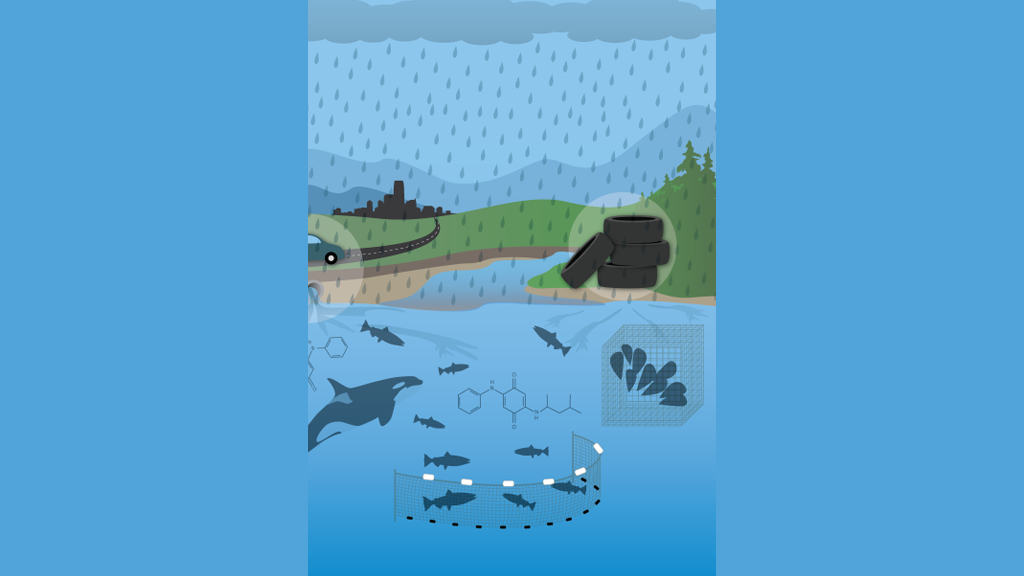

NOAA Scientists Develop New Method To Measure Toxic Tire Chemical In Marine Life, 6PPD-Quinone Can Kill Coho In Hours

Above photo: The tool developed in this study will help monitor the toxic tire chemical 6PPD-Q in aquatic and marine environments, and help us understand the potential to bioaccumulate in marine food webs. Credit: NOAA Fisheries

Scientists at NOAA’s Northwest Fisheries Science Center helped pioneer the study of an automobile tire toxin found to kill coho salmon when it runs off highways in stormwater and into streams. Now they have found a way to measure the toxin, 6PPD-quinone, directly in marine life, including fish, shellfish and marine mammals.

The new method can help scientists better understand how the toxin affects different species, and how it reaches and moves through marine ecosystems. It can help assess effects on more species in less time. That may, in turn, help managers find ways to reduce the risk it poses to salmon and other species.

“Without being able to measure it, we won’t be able to answer questions about its impacts on species,” said Li-Jung Kuo, who led research by the Science Center’s Environmental Chemistry Program to develop the new method. “We need to have a better understanding of 6PPD-Q distribution in the environment, including aquatic species. The capability to directly measure the 6PPD-Q body burden in aquatic species is a step forward, as it is essential for exposure assessment.”

The ecotoxicologists at the Science Center led research close to two decades ago that discovered “Urban Runoff Mortality Syndrome” which has led to mass die-offs of coho salmon in the Pacific Northwest during stormwater events. The lethal effects on coho salmon can occur in a matter of hours, even at very low concentrations. Recently, 6PPD-quinone was identified as the primary causal agent of the syndrome.

Continued research also identified inexpensive means of eliminating the toxic effects by filtering contaminated runoff through soil layers such as those in rain gardens. Highway construction in Washington and other states has begun to incorporate such solutions.

6PPD-quinone is a toxic chemical that forms when 6PPD, a common tire additive used to prevent cracking and degradation, reacts with ozone in the air. As tires wear down, tiny particles containing 6PPD are released onto roads. When it rains, stormwater runoff washes these particles and the resulting 6PPD-Q into streams, rivers, and on to the ocean.

Now scientists have developed an extraction method to measure 6PPD-Q in tissue samples from shellfish, finfish, and marine mammals. The method also measures other persistent pollutants, such as PCBs, PBDE flame retardants, organochlorine pesticides, and oil-related hydrocarbons. It allows researchers to understand the chemical’s potential impact on a broader range of species. It is the first method to directly document marine animals’ exposure in the wild.

Previous monitoring for 6PPD-Q has focused primarily on water, soil, atmospheric particulate matter, road dust, and sediment. The new protocol developed by NOAA scientists allows for the extraction and quantitative analysis of the chemical in complex tissues from various aquatic organisms. The method can be used to test tissues from finfish, shellfish, and even marine mammals.

This is a significant advancement because it allows scientists to:

• Assess the potential for 6PPD-Q to accumulate in species as it moves through aquatic food webs
• Assess environmental exposure of species to 6PPD-Q
• Streamline the analysis of 6PPD-Q into existing protocols with other persistent organic pollutants, assessing more pollutants in less time and for less cost

The development of this new method is a critical step in understanding the scope of exposure of marine species. It will guide future biomonitoring efforts in aquatic environments.

“This is a well-established problem, where we understand the cause and the response,” said Irvin Schultz, a research scientist at the Science Center and senior author of the new research. “Now we have a tool to help understand how it affects marine species and their ecosystem.”

Individuals can take steps to help reduce polluted runoff entering our waterways. Here’s how you can make a difference:

Install Rain Gardens and Bioswales

These natural filtration systems use a mix of soil, compost, and plants to capture and filter stormwater runoff before it enters storm drains. Research from NOAA has shown that these simple soil mixtures are highly effective at preventing toxic effects on fish.

Support Green Stormwater Infrastructure

Advocate for and support local projects that use natural systems like permeable pavement and rain gardens to manage stormwater.

Wash Your Car on the Lawn or at a Commercial Car Wash

Instead of washing your car in the driveway where soap and grime can run into the street, wash it on a grassy area that can absorb and filter the water. Commercial car washes also treat their wastewater, preventing pollutants from entering the storm drain system.

Also see:
–CBB, August 19, 2025, “Coho Urban Runoff Mortality Syndrome: WSU Research Team Discovers How Tire Chemical 6PPD Kills Coho, Step To Finding Alternative,” https://staging.columbiabasinbulletin.org/coho-urban-runoff-mortality-syndrome-wsu-research-team-discovers-how-tire-chemical-6ppd-kills-coho-step-to-finding-alternative/
–CBB, Nov. 16, 2023, “EPA Agrees To Begin Rulemaking On Risk To Salmon From 6PPD, A Chemical In Every Vehicle Tire; Kills Coho Within Hours,” https://staging.columbiabasinbulletin.org/epa-agrees-to-begin-rulemaking-on-risk-to-salmon-from-6ppd-a-chemical-in-every-vehicle-tire-kills-coho-within-hours/

Groups File Lawsuit Contending Steelhead Net Pen Aquaculture In Upper Columbia Polluting River, Violating Clean Water Permits

Two environmental groups are suing to halt what they say is pollution released from three commercial net pen aquaculture facilities that produce steelhead located on the Columbia River in Eastern Washington. The groups say Pacific SeaFood Aquaculture LLC has been violating its Clean Water Act permits since 2020 and has been harming wild fish and the river’s ecosystem, home to anadromous fish species listed under the federal Endangered Species Act.

The complaint, filed by the Wild Fish Conservancy and the Center for Food Safety, alleges the company has repeatedly violated the terms of its National Pollutant Discharge Elimination System permit in its process of raising the steelhead in Rufus Woods Lake, the reservoir backed up behind Chief Joseph Dam. The plaintiff nonprofits are represented by Kampmeier & Knutsen PLLC and CFS counsel.

The groups say that Pacific Seafoods markets the steelhead as “sustainably raised,” but that government records show the company has been “in continuous violation” of their NPDES permit conditions since at least April 2020 when the permits were reissued by the Washington Department of Ecology.

“Despite ‘sustainable’ marketing claims and third-party certifications, government records tell a different story— one of chronic noncompliance and ecological harm,” said Emma Helverson, Executive Director of Wild Fish Conservancy. “In the face of the public’s sustained, long-term efforts to protect and restore the Columbia River and its ecosystems, Pacific Seafood has repeatedly violated the Clean Water Act, undermining public trust, degrading water quality, and threatening the survival of wild salmon and steelhead. Local communities and economies should not be left to shoulder the costs of cleanup and ecological damage while a billion-dollar corporation cuts corners on basic environmental protections.”

Commercial aquaculture farms house fish in net pens, or floating facilities, that contain young and mature steelhead in enclosures, such as netting, in open water. The fish are hatched at freshwater hatcheries and the smolts are transferred to the net pens where they are cultivated to a marketable size.

In their court filing, the groups say that net pen aquaculture poses significant environmental and ecological risks, including “impacts associated with water pollution from feces, uneaten food, and pharmaceuticals or other chemicals used to treat the fish; disease and parasite amplification and transmission to wild aquatic species; and fish escapes that can disrupt the ecosystem.”

“These confined industrial fish farming operations have been unlawfully and egregiously polluting the Columbia River for years,” said George Kimbrell, CFS Legal Director. “Fish feed, fish waste, chemicals, pharmaceuticals, and other contaminants released by the facilities threaten water quality and native fish populations. We’re taking this action to ensure compliance with environmental laws designed to protect our waterways and the species that depend on them.”

In a news release, the groups listed the “adverse environmental and intertwined socioeconomic impacts” that results from net pen aquaculture. The long list of impacts include pollution from drugs, chemicals, pesticides, fungicides, pharmaceuticals, and other inputs; nutrient pollution from uneaten fish food and fish waste; the spread and amplification of parasites, viruses, and disease from farmed fish to wild fish; overfishing of forage fisheries in order to make fish meal and oil to grow aquacultured fish; adverse ecological effects on surrounding marine wildlife from the facilities; harm to traditional and indigenous fishing cultures and communities; and harm to recreational and commercial fisheries.

They add that chronic fish spills, caused by equipment failure, human error, or weather, are among the worst causes of harm. Escaped fish harm wild fish by competing for food and habitat, spreading viruses and disease, and inbreeding, reducing genetic diversity and resilience, says the complaint.

The groups noted that a net pen aquaculture facility in Puget Sound collapsed in August 2017. At the time, Cooke Aquaculture released an estimated 250,000 non-native and “viral infected Atlantic salmon into Puget Sound.” In early January this year, the state of Washington banned aquaculture facilities in the Sound. The groups added that some 25 million aquacultured fish had escaped net pens worldwide from 1996 through 2012.

Pacific Seafoods has violated its NPDEs permits by exceeding their effluent limitations, failing to properly monitor and report discharges, and failing to develop and implement plans for best management practices to reduce pollution in the manner required, the groups wrote in their complaint. They are seeking the court to:

  • Issue a declaratory judgment that Pacific has violated and continues to be in violation of the Permits;
  • Issue an injunction enjoining Pacific from operating the commercial steelhead net pen Facilities in a manner that results in further violations of the Permits or the CWA;
  • Issue an injunction requiring Pacific to take specific actions to evaluate and remediate the environmental harm caused by its violations;
  • Grant such other preliminary and/or permanent injunctive relief as Plaintiffs may from time to time request during the pendency of this case;
  • Order Pacific to pay civil penalties up to the maximum authorized by the CWA for each violation committed by Pacific
  • Award Plaintiffs their litigation expenses, including reasonable attorney fees and expert witness fees;
  • Grant Plaintiffs such additional relief as the Court deems just and proper.

The complaint and 60-day Notice are here: https://wildfishconservancy.org/wp-content/uploads/2025/07/001.0.complaint.pdf

For background, see:
— CBB, January 19, 2025, WASHINGTON STATE FORMALLY BANS NET PEN AQUACULTURE SEVEN YEARS AFTER NET PEN COLLAPSE RELEASED ATLANTIC SALMON INTO PUGET SOUND, HTTPS://COLUMBIABASINBULLETIN.ORG/WASHINGTON-STATE-FORMALLY-BANS-NET-PEN-AQUACULTURE-SEVEN-YEARS-AFTER-NET-PEN-COLLAPSE-RELEASED-ATLANTIC-SALMON-INTO-PUGET-SOUND/
— CBB, November 16, 2022, WASHINGTON DNR ENDS LEASES FOR REMAINING TWO NET PEN AQUACULTURE OPERATIONS (STERILE STEELHEAD) ON STATE-OWNED AQUATIC LANDS, HTTPS://COLUMBIABASINBULLETIN.ORG/WASHINGTON-DNR-ENDS-LEASES-FOR-REMAINING-TWO-NET-PEN-AQUACULTURE-OPERATIONS-STERILE-STEELHEAD-ON-STATE-OWNED-AQUATIC-LANDS/
–CBB, Jan. 27, 2022, WASHINGTON STATE SUPREME COURT ALLOWS COOKE AQUACULTURE TO FARM STERILE STEELHEAD IN STATE’S WATERS https://staging.columbiabasinbulletin.org/washington-state-supreme-court-allows-cooke-aquaculture-to-farm-sterile-steelhead-in-states-waters/

Spring Spill To Aid Salmon, Steelhead Passage Now Going Full Blast At Eight Columbia/Snake River Dams

Spring spill at Columbia/Snake River dams to aid juvenile salmon and steelhead in their migration through the hydro projects and out to the ocean is in full motion with all of the lower eight dams on the two rivers initiating full spill by April 10.
Full spill at the dams is coming after a month-long phase-in that began with partial spill March 1 at lower Snake River dams and at McNary Dam on the Columbia River. This was all due to an agreement to stay (delay) Columbia River basin litigation over dam operations in federal court. A stay for five years through Dec.13, 2028 was approved by U.S. District Court Judge Michael H. Simon on Feb. 8, 2024 with a potential stay for as long as 10 years.
The agreement also calls for the U.S. Army Corps of Engineers to spill more water over dams, beginning last spring, than in past years. Spilling instead of passing water through turbines at the dams offers a safe passage for the anadromous juvenile fish.
In the agreement known as the Columbia River Basin Restoration Initiative, the Corps committed to spill more water over spillways instead of through turbines during its annual spring spill operations at dams on the lower Snake and Columbia rivers, as well as expanding spill in the fall and early spring.
“This is an important component of the agreement with Tribes, States, and other parties to implement a long-term, durable path forward,” said Tim Dykstra, the Corps’ Northwestern Division Fish Policy lead. “We’ve been using spill as an important tool for fish passage since the mid-1990s to improve migratory conditions for juvenile salmon and steelhead and we will evaluate the impacts of the increased spill to inform our decisions in the future.”
In the past, spring spill began April 3 at the four lower Snake River dams and April 10 at the four lower Columbia River dams. 2024 was the first year of the agreement and partial spill began March 1 last year, as it did this year, at Ice Harbor, Lower Monumental, Little Goose, Lower Granite and McNary dams, spilling 4 hours each day through surface passage routes, mostly to assist upstream passage of migrating adult steelhead, the Corps said in a news release.
Beginning March 21, those projects, plus John Day Dam on the Columbia River, began spilling through surface passage routes 24 hours each day until regular spring spill began in April.
The Corps said it uses these operations to decrease the time it takes juvenile salmon and steelhead to move through the system of dams to the Pacific Ocean as well as provide other non-turbine passage routes.
Spring spill levels vary at each of the eight dams, but all projects have an upper limit that protects water quality from high levels of total dissolved gas, the Corps said. Even though this additional water is valuable for fish passage, managers must reduce spill amounts to keep from exceeding 125 percent TDG limits that state water quality agencies set, and EPA approved in Washington, which adds more intricacy to water management in the basin.
Spill operations driven by the litigation agreement and beginning April 10 at the dams are:
— Bonneville, McNary, Ice Harbor, Lower Monumental and Lower Granite dams will spill up to the 125 percent TDG levels 24 hours per day.
— The Dalles Dam will spill 40 percent of the river over the spillway.
— John Day Dam will spill 40 percent of the river over the spillway during the day and up to the 125 percent TDG levels and at night.
–Little Goose will also spill 16 hours per day up to the 125 percent TDG levels and reduce spill for eight hours to performance standard spill levels, or 30 percent of the river. This is to benefit adult fish passage.
“Consistent with our past coordination efforts with regional sovereigns and stakeholders, the Corps looks forward to working closely with our regional partners to ensure implemented operations benefit out-migrating juvenile salmonids, returning adult salmon, steelhead and lamprey as well as resident fish, while simultaneously providing for other important regional needs such as flood risk management, hydropower production, and navigation,” said Dykstra.
The Corps has other ways for juvenile fish to pass through the dams. For example, the agency’s Walla Walla District has a Juvenile Bypass System at Lower Granite Dam. Bonneville Dam uses a corner collector, spillway, juvenile bypass system and sluiceway.
For more information on juvenile passage improvements through lower Snake River dams, see the Corps’ fact sheet here: https://www.nww.usace.army.mil/Portals/28/docs/V2N/FactSheets%20not%20508/LSR%20Dams%20Fish%20Passage%20Improvements%2022%20Oct%202018_Page_1.jpg?ver=2019-07-09-123917-523.
A new advanced technology turbine designed for fish passage survival improvements was installed at Ice Harbor Dam in 2018. And, a juvenile collection and bypass system was built at Lower Granite Dam to “minimize turbine passage, increase fish survivability, and reduce injury in the existing bypass system,” the fact sheet says.
See CBB, March 7, 2024, Due To New Agreement On Columbia/Snake River Salmon Recovery, Spill For Fish At Federal Dams Starts A Month Earlier, https://staging.columbiabasinbulletin.org/due-to-new-agreement-on-columbia-snake-river-salmon-recovery-spill-for-fish-at-federal-dams-starts-a-month-earlier/
The stay in litigation and resulting Restoration Initiative is the result of multiple lawsuits since 2001 challenging NOAA Fisheries biological opinions of lower Snake and lower Columbia River dams and the Corps’ operations at those dams. As in previous litigation, the latest lawsuit by the National Wildlife Federation and others challenged the federal government’s 2020 environmental impact statement and biological opinion.
Simon first stayed this latest litigation in 2021 for one year and later extended the stay for a total of two years while White House-mediated discussions played out. Those discussions had the goal of a lasting agreement on how to operate the federal hydro system while recovering threatened and endangered salmon and steelhead. The result was a Dec. 14, 2023 memorandum of understanding – the Columbia Basin Restoration Initiative – that included the long-term stay in litigation along with hundreds of millions of dollars in salmon protection, Tribal wind and solar energy projects and federal support for planning efforts to replace the services provided by the lower Snake River dams.
At the end of February, the Biden administration, along with the governors of Oregon and Washington and leaders of four lower Columbia River tribes – the six sovereigns – formally signed the agreement. It commits the federal government to as much as $1 billion to build infrastructure for eventual removal of four lower Snake River dams and to recover salmon and steelhead in the Columbia River basin.
Although it does not specifically include removing or breaching the four lower Snake River dams, the actions of the MOU coupled with the federal commitments take big steps toward what would be needed before breaching the dams could take place. It would boost clean energy production to help offset the loss of the dams’ hydropower output, and it would build out transportation and provide other benefits provided by the dams if and when Congress could ever agree to breach them.
For background, see:
— CBB, Feb. 9 2024, PUBLIC POWER COUNCIL SEEKS NINTH CIRCUIT REVIEW OF BPA’S ACTIONS REGARDING SALMON RECOVERY MOU, HTTPS://CBBULLETIN.COM/PUBLIC-POWER-COUNCIL-SEEKS-NINTH-CIRCUIT-REVIEW-OF-BPAS-ACTIONS-REGARDING-SALMON-RECOVERY-MOU/
–CBB, Feb. 2, 2024, SALMON RECOVERY MOU A SECRET, RADICAL DEAL? REPUBLICANS SAY YES, ADMINISTRATION OFFICIALS SAY BRINGS STABILITY, HELPS FISH, CONTAINS COSTS, https://staging.columbiabasinbulletin.org/salmon-recovery-mou-a-secret-radical-deal-republicans-say-yes-administration-officials-say-brings-stability-helps-fish-contains-costs/
–CBB, Jan. 19, 2024, NEW FILING TAKES ISSUE WITH REQUESTS FOR DISTRICT COURT TO REJECT PROPOSED 5-YEAR DELAY OF COLUMBIA RIVER BASIN SALMON LITIGATION, https://staging.columbiabasinbulletin.org/new-filing-takes-issue-with-requests-for-district-court-to-reject-proposed-5-year-delay-of-columbia-river-basin-salmon-litigation/
–CBB, Jan. 18, 2024, IF COLUMBIA RIVER BASIN SALMON MOU APPROVED BY COURT, WHAT WILL BE THE ROLE OF NORTHWEST POWER/CONSERVATION COUNCIL? HARD TO SAY, https://staging.columbiabasinbulletin.org/if-columbia-river-basin-salmon-mou-approved-by-court-what-will-be-the-role-of-northwest-power-conservation-council-hard-to-say/
–CBB, Jan. 5, 2024, IDAHO, MONTANA, UTILITIES, PORTS FILE OPPOSITION TO PROPOSED SALMON RECOVERY MOU, STAY MEDIATED BY BIDEN ADMINISTRATION, https://staging.columbiabasinbulletin.org/IDAHO-MONTANA-UTILITIES-PORTS-FILE-OPPOSITION-TO-PROPOSED-SALMON-RECOVERY-MOU-STAY-MEDIATED-BY-BIDEN-ADMINISTRATION/
— CBB, December 15, 2023, BIDEN ADMINISTRATION, TWO STATES, TREATY TRIBES REACH MOU ON COLUMBIA RIVER BASIN SALMON RECOVERY, LITIGATION PAUSED FOR AT LEAST FIVE YEARS, https://staging.columbiabasinbulletin.org/biden-administration-two-states-treaty-tribes-reach-mou-on-columbia-river-basin-salmon-recovery-litigation-paused-for-at-least-five-years/
— CBB, Sept. 28, 2023, BIDEN ADMINISTRATION MEMO ORDERS FEDERAL AGENCIES TO REVIEW ALL COLUMBIA BASIN SALMON RECOVERY PROGRAMS, IDENTIFY NEEDS, PRIORITIZE ACTIONS, https://staging.columbiabasinbulletin.org/biden-administration-memo-orders-federal-agencies-to-review-all-columbia-basin-salmon-recovery-programs-identify-needs-prioritize-actions/

Washington State Gathers Info For Implementation Of TMDL Plan To Address High Water Temperatures In Columbia, Lower Snake Rivers

The Washington Department of Ecology is hosting a public meeting March 17 to discuss how it will implement a long-awaited Total Maximum Daily Load plan for temperature in the Columbia and lower Snake rivers. The two rivers are included in Washington’s 303(d) list of impaired bodies of water due to their persistent high water temperatures…

Read the full article…

Become a Member and get unlimited access to all articles.

Register

Already a member? Log in here

PSU Study Provides Evidence Microplastics Widespread In Edible Tissues Of The Fish People Eat On West Coast

Above: The team quantified anthropogenic particles that they found in the edible tissue of six species that are economically or culturally important in Oregon (clockwise from top left): Chinook salmon, lingcod, black rockfish, pink shrimp, Pacific herring, and Pacific lamprey (NOAA Fisheries, Oregon Department of Fish & Wildlife, North Carolina Wildlife Resource Commission).

The tiny particles that shed from clothing, packaging and other plastic products are winding up in the fish that people eat, according to a new study from Portland State researchers, highlighting a need for technologies and strategies to reduce microfiber pollution entering the environment.

The study, “From the ocean to our kitchen table: anthropogenic particles in the edible tissue of U.S. West Coast seafood species,” can be found here. https://www.frontiersin.org/journals/toxicology/articles/10.3389/ftox.2024.1469995/full

Building on previous research exploring the prevalence of microplastics in bivalves like Pacific oysters and razor clams, researchers in PSU’s Applied Coastal Ecology Lab — led by Elise Granek, professor of environmental science and management — turned their focus to commonly eaten finfish and crustaceans.

Summer Traylor, who graduated in 2022 with a master’s in environmental management, led the project with assistance from undergraduate environmental science student Marilyn Duncan, who graduated in 2024. The team set out to fill in gaps about microplastic contamination in Oregon finfish and shellfish and better understand variations across trophic levels, which classify a fish’s position in the food chain, and in pathways to consumers. Traylor’s research helped her land a job working for the National Oceanic and Atmospheric Administration after graduating from PSU, and Duncan has plans to continue microplastics research in graduate school.

The team quantified anthropogenic particles, materials produced or modified by humans, that they found in the edible tissue of six species that are economically or culturally important in Oregon: black rockfish, lingcod, Chinook salmon, Pacific herring, Pacific lamprey, and pink shrimp.

They compared particle concentrations across trophic levels and whether their position in the food web affected what and how much was contaminating their edible tissue as well as whether there were differences in samples acquired directly from research fishing vessels versus those from supermarkets and seafood vendors. Susanne Brander, an ecotoxicologist and associate professor in Oregon State University’s College of Agricultural Sciences, helped analyze and validate a subsample of suspected plastics in her lab.

The study, published in the journal Frontiers in Toxicology, found 1,806 suspected particles across 180 of 182 individual samples. Fibers were the most abundant, followed by fragments and films.

Among the species sampled, pink shrimp, which filter-feed right below the surface of the water, had the highest concentrations of particles in their edible tissues. Chinook salmon had the lowest concentrations, followed by black rockfish and lingcod.

“We found that the smaller organisms that we sampled seem to be ingesting more anthropogenic, non-nutritious particles,” Granek said. “Shrimp and small fish, like herring, are eating smaller food items like zooplankton. Other studies have found high concentrations of plastics in the area in which zooplankton accumulate and these anthropogenic particles may resemble zooplankton and thus be taken up for animals that feed on zooplankton.”

Though the group expected that the processing from catch to consumer would introduce additional contaminants from plastic packaging meant to preserve seafood, that wasn’t universally true across the species. The researchers rinsed off the fish fillets and shrimp, replicating what most people do at home before preparing them, suggesting that in some cases, additional contamination that may land on the surface during processing can be removed with rinsing.

The study results, however, provide evidence of the widespread presence of particles in the edible tissues of Oregon’s marine and freshwater species.

“It’s very concerning that microfibers appear to move from the gut into other tissues such as muscle,” Brander said. “This has wide implications for other organisms, potentially including humans too.”

The researchers say the findings signal the need for both further studies to understand the mechanisms by which particles translocate into muscle tissue, which humans eat, as well as policy interventions to regulate anthropogenic particles.

“This project established critical baseline data for West Coast fisheries stakeholders and highlighted how much we still do not know about these pervasive microplastic pollutants,” said Traylor, who now serves as a NOAA Corps Officer, helping collect baseline microplastic data in the Gulf of Mexico to further expand public knowledge and understanding.

The authors are not advocating for people to stay away from seafood because, as Granek likes to remind people, microplastics are everywhere: in bottled water, beer, honey, beef, chicken, veggie burgers and tofu.

“If we are disposing of and utilizing products that release microplastics, those microplastics make their way into the environment, and are taken up by things we eat,” she said. “What we put out into the environment ends up back on our plates.”

That’s why Granek’s lab group is beginning to focus more on solutions.

“We’re continuing to do work to understand the effects of anthropogenic particles on animals, but we’re also moving into experimental work to test what are effective solutions to reduce microplastics entering marine ecosystems,” she said.

She’s leading a $1.9 million NOAA-funded project that is developing and testing washing machine, dishwasher and clothes dryer filters that can serve as cost-effective filtration solutions. In another project funded by Oregon Sea Grant, six catch basin filters will be installed in stormwater drains in two coastal towns to determine their efficacy in trapping microplastics from road runoff before entering waterways. Brander’s lab is collaborating on both projects as well.

© Copyright 1997- 2026 Columbia Basin Bulletin. All rights reserved.
