
Trump Administration Pauses Columbia River Treaty Negotiations As It Reviews International Engagements

The U.S. has paused negotiations with British Columbia on a modernized Columbia River Treaty that was nearly complete after both the U.S. and Canada reached an Agreement in Principle in 2024. The AIP is yet to be ratified. The U.S. administration told British Columbia officials that it is conducting a broad review of its international engagement, according to a press release from the BC government.

The Columbia River Treaty governs flood control, water supply, hydropower and, in its newest iteration, provides more investment in ecosystem functions to restore salmon runs upstream of Grand Coulee Dam and into British Columbia.

During a virtual information session with nearly 600 participants hosted by British Columbia this week, Adrian Dix, Minister of Energy and Climate Solutions for B.C. said that such a pause in negotiations during a federal government transition is not unusual. He noted that a similar pause in Treaty negotiations occurred when President Joe Biden took office in 2021 after the first Trump administration. “It’s a regular practice to review processes,” he said. However, Treaty talks then resumed quickly.

This time is different, Dix said, especially with President Donald Trump’s trade wars and his reference to Canada as the U.S.’s 51st state.

“Quite a bit has changed with this new administration,” Dix said at the virtual session. “What’s different are the vicious attacks on Canada and our sovereignty and the threat of tariffs are making people think about the Treaty. Some say we should cancel the treaty and use it as a bargaining chip in our relations.”

On the other hand, Dix said, if Canada terminated the agreement, it would still take another ten years to finalize. Without a termination, the 61-year-old Columbia River Treaty between the two countries will continue indefinitely, except the first three years would include a changed flood risk management agreement.

“Canadian action to terminate the treaty would have little effect on the current dispute,” Dix said. “Our approach is to continue to work for the Treaty. The Treaty has support of politicians on both sides of the border.”

The Columbia River Treaty is a transboundary water-management agreement between Canada and the United States, ratified in 1964, that aims at coordinating flood-risk management and power generation on both sides of the border, to the benefit of both countries.

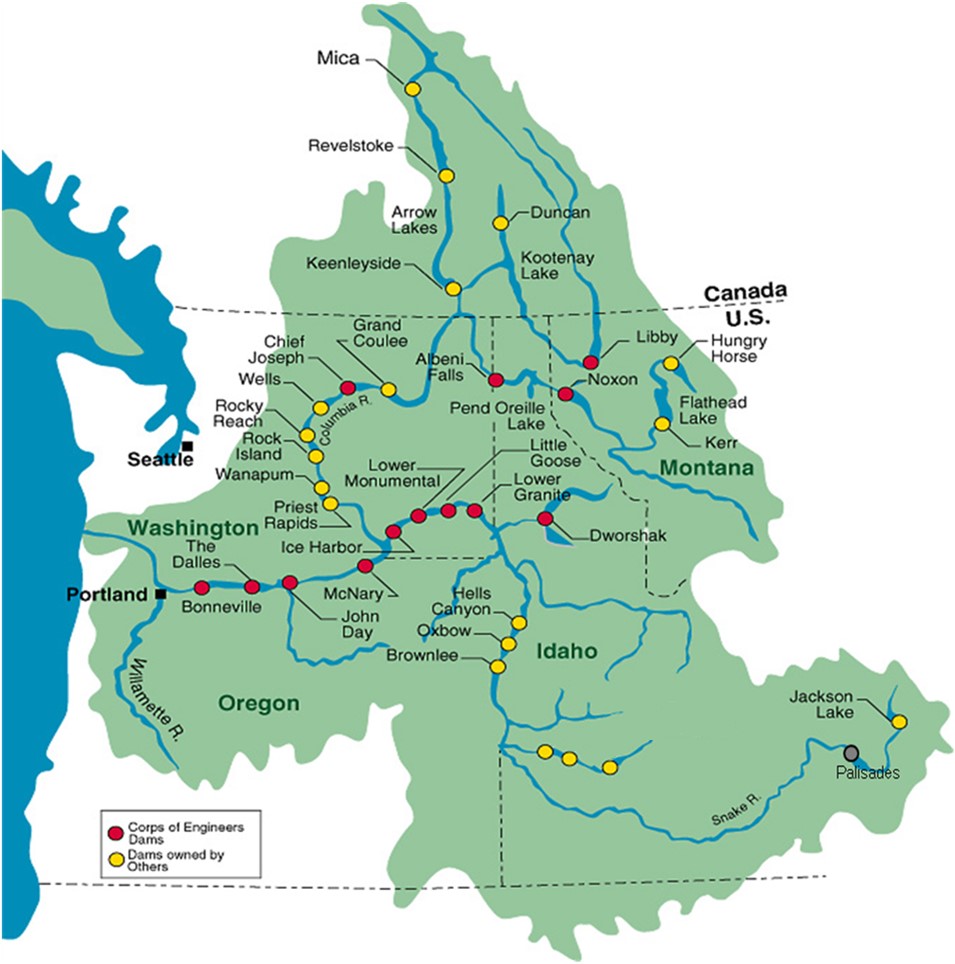
The treaty required Canada to build three dams – Duncan (1967), Hugh L. Keenleyside (1968) and Mica (1973) – in B.C. and allowed the U.S. to build a fourth dam, the Libby Dam (1975), that flooded into Canada.

Although international treaties are within the jurisdiction of the federal government, the 1963 Canada-British Columbia Agreement transferred most treaty rights and obligations to the province and requires the province’s agreement before terminating or amending the treaty, Dix noted.

The AIP enables B.C. to continue receiving a share of the additional hydroelectric power potential in the U.S. as a result of how B.C. operates its treaty dams, and includes newly negotiated access to U.S. transmission infrastructure. It also provides annual indexed compensation from the U.S. for a reduced volume of reservoir space for flood-risk management and for other benefits the U.S. receives, including benefits to irrigation, navigation, recreation and fish-population enhancements in the U.S. portion of the Columbia Basin.

According to the AIP, Canada will store several million-acre-feet of water that can be used in 2025 and for the next 20 years to help prevent floods in the Columbia River basin downstream in the U.S., according to federal dam operators speaking in December on the AIP’s flood risk management protections. That’s about half the amount of pre-planned flood control storage provided over the past 61 years when the 1964 Columbia River Treaty agreement was in effect.

Beginning this year Canadians will hold back some 3.6 MAF of preplanned space each year at the Hugh Keenleyside Dam (Arrow Dam) in British Columbia to aid flood risk management in the U.S. at Grand Coulee Dam and lower downstream in the Columbia River, mostly during spring runoff when water levels in the river rise. That’s a drop from the as much as 7.1 MAF of preplanned storage from Canada for flood risk management that was included in the previous Treaty agreement. In the earlier Treaty, about 5.1 MAF was dedicated for flood control management with an additional 2 MAF of accessible storage when needed in real time.

The new arrangement places more of the responsibility on the U.S. to manage its own flood risks and that will require changes to flood control protocols at Coulee and at the John Day Dam further downstream on the Columbia.

“The Canadian portion of the Columbia River in Canada may seem small, but it is responsible for much of the flooding lower in the river,” General William C. Hannon Jr. said at a mid-December virtual Treaty briefing. Hannon is commander of the U.S. Army Corps of Engineers’ Northwest Division office. “Nearly 40 percent of the floodwaters originate in Canada.”

In certain spring runoff conditions when flooding is threatened, the difference in storage between the 7.1 MAF of the previous Treaty and the preplanned 3.6 MAF of the new Treaty will have to be made up by drawing down both Lake Roosevelt, the reservoir backed up behind Grand Coulee Dam and the John Day Dam, effectively providing more of the storage needed to deter flooding in the U.S.

See CBB, December 15, 2024, “Agencies Explain How New Columbia River Treaty ‘Agreement In Principle’ Will Alter Flood Control Operations; Less Pre-Planned Storage In Canada,” https://staging.columbiabasinbulletin.org/agencies-explain-how-new-columbia-river-treaty-agreement-in-principle-will-alter-flood-control-operations-less-pre-planned-storage-in-canada/

There is little worry about flooding this year, Kathy Eichenberger, lead Treaty negotiator for British Columbia, said at the province’s virtual session this week, Tuesday, March 25.

“Columbia River reservoir operations will be easier to operate this year,” she said. “Although it’s still too early to forecast if the Columbia River basin will have low or an average water year, it appears that there will be no chance of flooding this year.”

For details of the AIP and regional and federal reaction, see: CBB, July 12, 2024, “U.S., Canada Reach ‘Agreement-In-Principle’ For Modernized Columbia River Treaty; Assures Pre-Planned Flood Control, Rebalances Power Benefits,” https://staging.columbiabasinbulletin.org/u-s-canada-reach-agreement-in-principle-for-modernized-columbia-river-treaty-assures-pre-planned-flood-control-rebalances-power-benefits/

The AIP that took effect in September 2024 is a roadmap for each country’s negotiation team to modernize the 60-year-old Columbia River Treaty, which has played an important role in guarding against and reducing flood damage in the U.S. and providing electricity to millions of households, businesses and industries in both countries.

Originally ratified in 1964, the countries have agreed to continue the transboundary water management agreement, but with the addition of provisions that protect and support communities and ecosystems in both countries. The AIP took B.C. and U.S. treaty negotiators some six years to negotiate.

See CBB, September 28, 2024, Canada Looking For A New Columbia River Treaty To Promote Ecosystem Functions, Cultural Values Of B.C., First Nations, https://staging.columbiabasinbulletin.org/canada-looking-for-a-new-columbia-river-treaty-to-promote-ecosystem-functions-cultural-values-of-b-c-first-nations/

While the original Treaty was in effect, Canada had committed for 60 years to store water to reduce the risk of flood downstream in the U.S. Prior to the 1964 Treaty, which led to the construction of several storage dams in British Columbia and the John Day Dam in the lower Columbia River, flooding would typically occur up and down the Columbia River, hitting especially hard in population areas such as Portland and Vancouver, as well as Washington’s Tri-Cities.

As an example, with the storage dams protecting downstream locations, flood stage at Vancouver is currently at 16 feet elevation. However, without the storage provided by Canadian, Grand Coulee and John Day dams, flood levels could reach 25 feet in elevation, a full 10 feet above flooding today, and the high flows could last as much as a week longer, Barton said.

The countries have also agreed to incorporate new provisions not considered in the original agreement, including those for increased unilateral flexibility for how British Columbia operates its treaty dams, ecosystem health, restoring and strengthening salmon populations, Indigenous cultural values, adaptive management and new collaborative engagement on Libby Dam operations.

Columbia River Treaty British Columbia website is at https://engage.gov.bc.ca/columbiarivertreaty/agreement-in-principle/

For background, see:

— CBB, August 9, 2024, Guest Column: Canada-U.S. ‘Agreement-In-Principle’ Sets Stage For More Balanced Columbia River Treaty, https://staging.columbiabasinbulletin.org/guest-column-canada-u-s-agreement-in-principle-sets-stage-for-more-balanced-columbia-river-treaty/

–CBB, Oct. 13, 2023, Without A New Columbia River Treaty Corps Will Need To Use ‘Real-Time’ Flood Control, Rather Than ‘Assured Storage’ In Canadian Reservoirs, https://staging.columbiabasinbulletin.org/without-a-new-columbia-river-treaty-corps-will-need-to-use-real-time-flood-control-rather-than-assured-storage-in-canadian-reservoirs/

— CBB, June 30,2021, NW Lawmakers Send Letter To Biden Urging ‘White House Led Strategy’ On Columbia River Treaty, Seek Reducing ‘Canadian Entitlement’; Conservationists’ Letter Stresses ‘Health Of The River’ https://staging.columbiabasinbulletin.org/nw-lawmakers-send-letter-to-biden-urging-white-house-led-strategy-on-columbia-river-treaty-seek-reducing-canadian-entitlement-conservationists-letter-str/

— CBB, June 16, 2023, New Agreements Give Canada’s Indigenous Nations Revenue Sharing From Benefits Of Columbia River Treaty, https://staging.columbiabasinbulletin.org/new-agreements-give-canadas-indigenous-nations-revenue-sharing-from-benefits-of-columbia-river-treaty/

— CBB, May 24, 2023, Columbia River Treaty Negotiators Meet In Kelowna; Discuss Salmon Reintroduction, Flood-Risk Management, https://staging.columbiabasinbulletin.org/columbia-river-treaty-negotiators-meet-in-kelowna-discuss-salmon-reintroduction-flood-risk-management/

— CBB, April 20, 2023, As Expiration Date Nears, U.S., Canada Pushing To Finish Columbia River Treaty Negotiations By June; Uncertainty Over Future Operations A Motivator, https://staging.columbiabasinbulletin.org/as-expiration-date-nears-u-s-canada-pushing-to-finish-columbia-river-treaty-negotiations-by-june-uncertainty-over-future-operations-a-motivator/

Agencies Explain How New Columbia River Treaty ‘Agreement In Principle’ Will Alter Flood Control Operations; Less Pre-Planned Storage In Canada

Canada will store several million-acre-feet of water that can be used in 2025 and for the next 20 years to help prevent floods in the Columbia River basin downstream in the United States, according to a virtual briefing earlier this month by federal dam operators on the Columbia River Treaty Agreement in Principle’s flood risk management protections.

However, that’s just about half the amount of pre-planned flood control storage provided over the past 60 years when the 1964 Columbia River Treaty agreement was in effect.

In 2025, Canadians will hold back some 3.6 MAF of preplanned space each year at the Hugh Keenleyside Dam (Arrow Dam) in British Columbia to aid flood risk management in the U.S. at Grand Coulee Dam and lower downstream in the Columbia River, mostly during spring runoff when water levels in the river rise. That’s a drop from the as much as 7.1 MAF of preplanned storage from Canada for flood risk management that was included in the previous Treaty agreement. In the earlier Treaty agreement, about 5.1 MAF was dedicated for flood control management with an additional 2 MAF of accessible storage when needed in real time.

The new arrangement for 2025 places more of the responsibility on the U.S. to manage its own flood risks and that will require changes to flood control protocols at Coulee and at the John Day Dam further downstream on the Columbia.

“The Canadian portion of the Columbia River in Canada may seem small, but it is responsible for much of the flooding lower in the river,” General William C. Hannon Jr. said at the virtual Treaty briefing, Dec. 4. Hannon is commander of the Corps’ Northwest Division office. “Nearly 40 percent of the floodwaters originate in Canada.”

In certain spring runoff conditions when flooding is threatened, the difference in storage between the 7.1 MAF of the previous Treaty and the preplanned 3.6 MAF of the new Treaty will have to be made up by drawing down both Lake Roosevelt, the reservoir backed up behind Grand Coulee Dam and the John Day Dam, effectively providing more of the storage needed to deter flooding in the U.S.

“Grand Coulee will likely experience deeper and longer duration drawdowns in some years,” said Steve Barton, chief of the U.S. Army Corps of Engineers’ Water Management Division. “Flows downstream will generally remain the same.” Grand Coulee is operated by the Bureau of Reclamation.

Barton said that Coulee is a huge storage dam and can be drafted 82 feet from a low 1,208 feet elevation above sea level to 1,290 feet of elevation. “Without the agreement, Coulee could have been drafted even lower,” he said.

In dry to average years, which is 60 percent of all years, the BOR would on average draft Coulee to a low of 1,270 feet prior to the new Treaty, but in 2025 Coulee could be drafted to as low as 1,260 feet.

With above average water, which is 30 percent of years, the Bureau could draft Coulee 7 feet deeper in 2025 at some point during March through May.

In very wet years, which is 10 percent of years, there would be very little change from the old Treaty to the new. That’s because Coulee will already be drafted to a low level to account for deep snowpacks.

The driest l0 percent of years and the wettest 10 percent should be similar, Barton said.

The Corps could also call on the John Day Dam and its reservoir for storage space. Although seldom used for storage or flood control, Barton said the dam and its reservoir is authorized for flood control use. The reservoir can be drawn down as much as 11 feet at some point between April and June.

“Before Sept. 2024, this operation was needed approximately 10 percent of the years,” he said. “Moving forward, we expect to see this in about 20 percent of years.”

Flood risk management is a provision of the Columbia River Treaty Agreement in Principle reached by the two countries July 11. The AIP that took effect in September is a roadmap for each country’s negotiation team to modernize the 60-year-old Columbia River Treaty, which has played an important role in guarding against and reducing flood damage in the U.S. and providing electricity to millions of households, businesses and industries in both countries. Originally ratified in 1964, the countries have agreed to continue the transboundary water management agreement, but with the addition of provisions that protect and support communities and ecosystems in both countries. The original Treaty expired this year in September.

The AIP took British Columbia and U.S. treaty negotiators some six years to negotiate. Canada and the U.S. are in the process of negotiating interim agreements that would be in effect during the period between when the AIP was reached and a modernized Treaty is brought into play.

See CBB, September 28, 2024, CANADA LOOKING FOR A NEW COLUMBIA RIVER TREATY TO PROMOTE ECOSYSTEM FUNCTIONS, CULTURAL VALUES OF B.C., FIRST NATIONS, HTTPS://COLUMBIABASINBULLETIN.ORG/CANADA-LOOKING-FOR-A-NEW-COLUMBIA-RIVER-TREATY-TO-PROMOTE-ECOSYSTEM-FUNCTIONS-CULTURAL-VALUES-OF-B-C-FIRST-NATIONS/

While the original Treaty was in effect, Canada had committed for 60 years to store water to reduce the risk of flood downstream in the U.S. Prior to the 1964 Treaty, which led to the construction of several storage dams in British Columbia and the John Day Dam in the lower Columbia River, flooding would typically occur up and down the Columbia River, hitting especially hard in population areas such as Portland and Vancouver, as well as Washington’s Tri-Cities.

As an example, with the storage dams protecting downstream locations, flood stage at Vancouver is currently at 16 feet elevation. However, without the storage provided by Canadian, Grand Coulee and John Day dams, flood levels could reach 25 feet in elevation, a full 10 feet above flooding today, and the high flows could last as much as a week longer, Barton said.

The Corps hosted two virtual updates specifically focusing on flood risk management, Dec. 4 and Dec. 5. Recordings of the sessions are here: https://www.nwd.usace.army.mil/crwm/columbia-river-treaty/

In its announcement for the virtual sessions, the Corps said that since signing the AIP, both countries have been developing how to proceed with a modernized Treaty regime. Until the new regime is in force, the two countries will be in an interim period in which the Corps has worked with Canada to secure the 3.6 MAF of preplanned flood risk management storage for 2025.

“If U.S. FRM (flood risk management) reservoirs and the 3.6 MAF of preplanned space in Canada are insufficient to address U.S. flooding, the U.S. will exercise its right to ‘call’ Canada for additional space under the Columbia River Treaty,” the Corps said.

Other Impacts Downstream

Eric Rothwell of the Bureau of Reclamation said the flood control changes made in U.S. waters will have little impact on upper Columbia River tribal salmon reintroduction efforts, although it could have a small effect on scheduling and costs of those efforts when flows are higher, but the impacts should be limited.

However, the changes, including higher river flow, could impact the migration of juvenile and adult salmon and steelhead. Those higher flows coming across the border, Rothwell said, can often be reregulated and shaped. Higher flows resulting from 2025 Treaty operations could also increase total dissolved gas levels at some Columbia River dams that are higher than the 125 percent TDG limit. River temperature during the spring and early summer will likely not be affected, he said.

Although it has little to do with flood control management, the new Treaty agreement in principle will provide an additional 1.1 MAF of flow augmentation from Canada in the summer to support fish.

Resident fish in Lake Roosevelt could be adversely impacted during very low reservoir drawdowns.

Barton said that higher than normal seasonal flows will occur just a few days each year, but there could be a higher cost for barge transportation, especially when more tugs are added to each barge heading upstream as flows increase and the stronger current slows barge traffic. He added that “I do not anticipate that shipping will be interrupted with real time flood risk management.”

Rothwell said that deep drawdowns in Lake Roosevelt and at the John Day Dam could impact irrigation withdrawals. A drawdown could prevent or slow pumping water from Lake Roosevelt back up into Banks Lake for future use (pumped storage, irrigation and re-regulating Grand Coulee).

In addition, the reservoir behind John Day Dam rarely gets below the minimum irrigation level, but with a deep drawdown there could be a brief impact on irrigation pumping for agriculture, he said.

The drawdowns could impact recreational activities when lowered lake levels leave some boat ramps on Lake Roosevelt and the John Day reservoir high and dry, Rothwell said. In addition, some Native American cultural sites could be exposed in Lake Roosevelt during extreme drawdowns. In that case, they could be vulnerable to looting or damage from erosion.

The Inchelium-Gifford Ferry on Lake Roosevelt will likely realize significant impacts on scheduling during deep drawdowns, Rothwell said. While ferry outages are currently infrequent, with the drawdown they could be longer.

There will be no flood risk impacts in the Snake River as the dams are not affected by Columbia River risk management operations, said General Hannon. “Likewise, they (lower Snake River dams) have no storage aside from their operating pools, and thus have no bearing on the mainstem flood risk management,” he said.

Columbia River Treaty British Columbia website is at https://engage.gov.bc.ca/columbiarivertreaty/agreement-in-principle/

For background, see:

— CBB, August 9, 2024, Guest Column: Canada-U.S. ‘Agreement-In-Principle’ Sets Stage For More Balanced Columbia River Treaty, https://staging.columbiabasinbulletin.org/guest-column-canada-u-s-agreement-in-principle-sets-stage-for-more-balanced-columbia-river-treaty/

–CBB, July 12, 2024, U.S., Canada Reach ‘Agreement-In-Principle’ For Modernized Columbia River Treaty; Assures Pre-Planned Flood Control, Rebalances Power Benefits, https://staging.columbiabasinbulletin.org/u-s-canada-reach-agreement-in-principle-for-modernized-columbia-river-treaty-assures-pre-planned-flood-control-rebalances-power-benefits/

–CBB, Oct. 13, 2023, Without A New Columbia River Treaty Corps Will Need To Use ‘Real-Time’ Flood Control, Rather Than ‘Assured Storage’ In Canadian Reservoirs, https://staging.columbiabasinbulletin.org/without-a-new-columbia-river-treaty-corps-will-need-to-use-real-time-flood-control-rather-than-assured-storage-in-canadian-reservoirs/

— CBB, June 30,2021, NW Lawmakers Send Letter To Biden Urging ‘White House Led Strategy’ On Columbia River Treaty, Seek Reducing ‘Canadian Entitlement’; Conservationists’ Letter Stresses ‘Health Of The River’ https://staging.columbiabasinbulletin.org/nw-lawmakers-send-letter-to-biden-urging-white-house-led-strategy-on-columbia-river-treaty-seek-reducing-canadian-entitlement-conservationists-letter-str/

— CBB, June 16, 2023, New Agreements Give Canada’s Indigenous Nations Revenue Sharing From Benefits Of Columbia River Treaty, https://staging.columbiabasinbulletin.org/new-agreements-give-canadas-indigenous-nations-revenue-sharing-from-benefits-of-columbia-river-treaty/

— CBB, May 24, 2023, Columbia River Treaty Negotiators Meet In Kelowna; Discuss Salmon Reintroduction, Flood-Risk Management, https://staging.columbiabasinbulletin.org/columbia-river-treaty-negotiators-meet-in-kelowna-discuss-salmon-reintroduction-flood-risk-management/

— CBB, April 20, 2023, As Expiration Date Nears, U.S., Canada Pushing To Finish Columbia River Treaty Negotiations By June; Uncertainty Over Future Operations A Motivator, https://staging.columbiabasinbulletin.org/as-expiration-date-nears-u-s-canada-pushing-to-finish-columbia-river-treaty-negotiations-by-june-uncertainty-over-future-operations-a-motivator/

Canada Looking For A New Columbia River Treaty To Promote Ecosystem Functions, Cultural Values Of B.C., First Nations

In a Columbia River Treaty “Agreement in Principle” with the United States, Canada will set aside 4-million-acre-feet of water each year that in the past has been used for power production. This water stored behind Canadian dams instead will be used to promote ecosystem functions and socio-economic and cultural values of British Columbia and its First Nations, according to an information session by B.C. Treaty negotiators last week.

Read the full article…

Become a Member and get unlimited access to all articles.

Register

Already a member? Log in here
© Copyright 1997- 2026 Columbia Basin Bulletin. All rights reserved.