
New NOAA Status Review Shows Olympic Peninsula Wild Steelhead Numbers In Steep Decline, Now At Moderate Risk Of Extinction
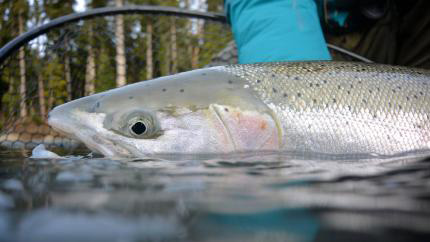
A wild winter steelhead caught in a Washington coastal river on the Olympic Peninsula held in the water prior to release. Photo by Chase Gunnell
A NOAA Fisheries biological status review team has determined that the summer and winter Olympic Peninsula steelhead are at moderate risk of extinction, a reversal of the previous status review in the 1990s that had determined the fish were not at risk of becoming threatened or endangered then or in the future.
The review was done in response to a petition by two conservation groups in August 2022 asking the federal agency to reevaluate the OP steelhead status. The petition by The Conservation Angler and the Wild Fish Conservancy had claimed that the number of summer fish had declined since the 1990s, that catch of winter fish is resulting in a much smaller return than was historically found in the rivers and that large numbers of non-Olympic Peninsula hatchery steelhead were showing up in OP rivers, according to the status review team’s report (“Biological Status of the Olympic Peninsula Steelhead Distinct Population Segment,” https://www.fisheries.noaa.gov/s3//2024-11/nwfsc-tech-memo-198.pdf).
The groups’ petition said that summer steelhead populations had declined by as much as 37 to 46 percent (1980 – 2017) in the Hoh, Queets and Quinault rivers, with the Hoh and Queets rivers “increasingly failing to meet their escapement goals.” Winter steelhead, the petition said, are in even more trouble, with steep declines in populations (compared to 1940 – 1960 counts) in the Quillayute (61 percent decline), the Queets (60 percent decline), Hoh (79 percent decline) and the Quinault (81 percent decline).
The Quinault River run size has dropped from an estimated 9,000 fish in 1985 to under 2,000 fish in 2021. The Queets/Clearwater dropped from about 10,250 in 1982 to about 3,000 in 2021. The Hoh dropped from nearly 6,000 in 1982 to about 3,300 fish in 2021. The Quillayute has a more varied run size history. It was experiencing low runs in the early 1980s as low as 8,000 fish, rising to a high of about 23,000 in 1997 and then declining to about 6,000 in 2021.
The total run in all Olympic rivers dropped from over 50,000 fish in the 1980s to 25,723 in 2021, the lowest on record.
“The summer-run component is nearly extinct, and the winter-run component is declining and losing its life history diversity,” the petition said. “The fate of the species now rests on a depressed and contracted mid- to late-spring component of wild fish whose productivity is limited or declining depending on the population. The remnants of these runs that historically numbered in the tens of thousands face declining freshwater and marine habitat conditions, increasing recreational fishing pressure, and ongoing commercial harvest. Because of these and other demographic and ecological threats, Olympic Peninsula steelhead are likely to become endangered within the foreseeable future.”
Responding to the groups’ petition, NOAA Fisheries announced in February 2023 it would conduct a status review of whether OP winter and summer steelhead should be listed as threatened or endangered.
See CBB, February 17, 2023, NOAA FISHERIES TO CONDUCT STATUS REVIEW OF OLYMPIC PENINSULA WILD STEELHEAD TO DETERMINE IF ESA LISTING WARRANTED, HTTPS://COLUMBIABASINBULLETIN.ORG/NOAA-FISHERIES-TO-CONDUCT-STATUS-REVIEW-OF-OLYMPIC-PENINSULA-WILD-STEELHEAD-TO-DETERMINE-IF-ESA-LISTING-WARRANTED/
OP steelhead are the wild steelhead originating from the Elwha River on the north side of the Olympic Peninsula to rivers as far south as Grays Harbor on the Washington Coast. The Winter-returning steelhead migrate into both small and large rivers of the Peninsula, while summer-returning steelhead mostly migrate into the Peninsula’s larger rivers. The larger rivers include the Hoh, Queets, Quinault/Clearwater and Quilcene/Sol Duc/Bogachiel rivers.
The review team looked at new information on the numbers of fish caught as well as estimates of the number of fish that survived to spawn. In addition, it looked at information about each Distinct Population Segment’s boundaries and risk of extinction, such as the biological and demographic status of natural-origin OP steelhead, past and current harvest and hatchery operations, current watershed habitat conditions as well as predictions of the effects of climate change on the fish, past and present fisheries harvest, and past and present land use.
Although there is still some uncertainty in the overall effects of climate change on freshwater and ocean habitat on the Olympic Peninsula, the review says, “there have already been marked decreases in glacial coverage, increases in summer stream temperatures, decreases in summer stream hydrology, and deleterious changes in ocean conditions.” These are trends the review says are expected to continue and will increasingly threaten the 39 steelhead populations of the OP.
Among the review team’s conclusions are:
— There was no new information suggesting that changes were needed in the composition of the DPS.
— There had been a strong decline in the number of steelhead returning to the rivers of the Olympic Peninsula. In 1996, of the 12 populations for which trends could be calculated (1991–95), seven were found to be declining and five increasing. Today, of the 14 populations for which five-year trends could be calculated (2018–22), no populations were increasing, one was stable, and 13 were declining. Run size (escapement plus harvest), which is only available for winter-run populations in the four largest rivers, has declined by 42 percent, from 32,556 (1991–95) to 18,821 (2018–22).
— Kelt survival rates have dropped from about 20 percent to about 12 percent since 1996. “This likely has had a negative effect on overall population reproductive potential, as kelts have a disproportionate influence on population productivity, spawning multiple times and with a higher fecundity than maiden (first-time) spawners,” the review says.
— Until recently, a large fraction of returning steelhead had been harvested before they could spawn. “Harvest rates on natural-origin steelhead have been excessive for many winter-run populations (Quillayute, Hoh, Queets, and Quinault River basins, with harvest rates averaging 20–45% from 1996–2020),” the review says. “At these harvest rates, populations in the four major basins are below replacement. In recent years (2020–22), harvest rates were lower (about 10% on average in the four major basins) due to low forecasted returns, near or below escapement goals.”
— Information on summer-returning steelhead was very limited, but what was available indicated that there are very few remaining in the DPS, but the review does say that available information suggests that summer-run populations are at a level where the “risks of catastrophic events and demographic processes are of concern.”
— Hatchery fish, because they did not originally come from the DPS, could put OP steelhead at risk if they spawn with local fish, because genes not adapted for the OP environment could be introduced into OP steelhead. Also, fishers trying to catch hatchery fish may be catching a lot of local native fish.
— Habitat conditions were good in the Olympic National Park, but outside of the Park there has been intensive tree cutting. Still, much of the forest and river habitat is slowly recovering.
— Climate change is likely to result in summertime river temperatures being too warm, with river flows diminished. Winter snowfall will transition to rain in the future, often in the form of major rainfall events. The loss of glaciers in the Olympic Mountains is already proceeding at a rapid rate, and it is likely that they will be gone completely by the end of this century, the review says.
Not all of the review team agreed that the fish are at moderate risk of extinction. Of the eight members on the team six came to that conclusion, but one put the population at low risk of extinction and the eighth member split on moderate/no risk depending on DPS.
A population is at moderate risk of extinction, according to NOAA Fisheries “…if it exhibits a trajectory indicating that it is more likely than not to reach a high level of extinction risk in the foreseeable future. A species/DPS may be at moderate risk of extinction due to projected threats and/or declining trends in abundance, productivity, spatial structure or diversity. The appropriate time horizon for evaluating whether a species or DPS is more likely than not to become at high risk in the future depends on the various case- and species-specific factors. For example, the time horizon may reflect certain life-history characteristics (e.g., long generation time or late age-at-maturity) and may also reflect the timeframe or rate over which identified threats are likely to impact the biological status of the species or DPS (e.g., the rate of disease spread). The appropriate time horizon is not limited to the period that status can be quantitatively modeled or predicted within predetermined limits of statistical confidence.”
The review team was made up of representatives from NOAA’s Northwest Fisheries Science Center in Seattle and its Southwest Fisheries Science Center in La Jolla, California, the Olympic National Park and its West Coast Regional Office in Portland. They also met with representatives from the Washington Department of Fish and Wildlife, the Northwest Indian Fisheries Commission and tribal nations within the OP Steelhead DPS or with treaty/management interests within the DPS, the review says.
NOAA Fisheries will evaluate ongoing and proposed steelhead conservation efforts to figure out if they may reduce threats to the population and the degree of certainty around their implementation. Once that is done, it will publish a finding on the petition in the Federal Register. A finding that ESA listing is not warranted, will result in no further action. A finding that listing may be warranted, will include a proposal to list the species and solicit comments before a final decision is made, according to the agency.
For background, see:
— CBB, February 17, 2023, NOAA FISHERIES TO CONDUCT STATUS REVIEW OF OLYMPIC PENINSULA WILD STEELHEAD TO DETERMINE IF ESA LISTING WARRANTED, HTTPS://COLUMBIABASINBULLETIN.ORG/NOAA-FISHERIES-TO-CONDUCT-STATUS-REVIEW-OF-OLYMPIC-PENINSULA-WILD-STEELHEAD-TO-DETERMINE-IF-ESA-LISTING-WARRANTED/
— CBB, April 27, 2022, OLYMPIC PENINSULA GLACIERS, SNOWFIELDS DISAPPEARING FAST; DIMINISHING STREAMS FOR FISH, HTTPS://CBBULLETIN.COM/OLYMPIC-PENINSULA-GLACIERS-SNOWFIELDS-DISAPPEARING-FAST-DIMINISHING-STREAMS-FOR-FISH/
— CBB, March 31, 2022, OREGON COAST STEELHEAD RETURNS SHOWING BETTER NUMBERS THAN WASHINGTON; OREGON LOOKING FOR PUBLIC INPUT ON COLUMBIA RIVER STEELHEAD MANAGEMENT, HTTPS://CBBULLETIN.COM/OREGON-COAST-STEELHEAD-RETURNS-SHOWING-BETTER-RETURNS-THAN-WASHINGTON-OREGON-LOOKING-FOR-PUBLIC-INPUT-ON-COLUMBIA-RIVER-STEELHEAD-MANAGEMENT/
— CBB, January 27, 2022, BAD TREND FOR OLYMPIC PENINSULA WILD STEELHEAD: POPULATIONS DOWN MORE THAN HALF SINCE 1950S, FISH RETURNING 1-2 MONTHS LATER, HTTPS://CBBULLETIN.COM/BAD-TREND-FOR-OLYMPIC-PENINSULA-WILD-STEELHEAD-POPULATIONS-DOWN-MORE-THAN-HALF-SINCE-1950S-FISH-RETURNING-1-2-MONTHS-LATER/
— CBB, Nov. 4, 2021, LIKE COLUMBIA RIVER, WASHINGTON COAST SEES WORST STEELHEAD RETURNS EVER, LIKELY TO GET WORSE; WDFW MULLS ANGLING RESTRICTIONS, https://columbiabasinbulletin.org/like-columbia-river-washington-coast-sees-worst-steelhead-returns-ever-likely-to-get-worse-wdfw-mulls-angling-restrictions/

- Columbia Basin Snowmelt, Runoff In Most Areas Early, Rapid; Water Supply Forecasts May-September Dropping - 05.15.2025
- Spring Runoff Older Than You Think: Hydrologists Show Mountain Streamflow Old Snowmelt On Years-Long Underground Journey - 05.15.2025
- Columbia River Harvest Managers Confirm Spring Chinook Return On Track, Approve 14 More Fishing Days - 05.15.2025


Leave a Reply
Want to join the discussion?Feel free to contribute!